Published .
The starting point
At a glance
- Prepare separate spaces and resources before the cats meet.
- Progress only while both cats are comfortable with the current stage.
- Step back when tension appears and seek help for persistent conflict.
Introducing cats is a process of helping each animal feel safe while learning about an unfamiliar housemate. It involves the resident cat’s experience as much as the newcomer’s. A successful outcome may be comfortable coexistence, without the cats choosing to sleep together or groom one another.
Cats vary in their social preferences. Sharing an address does not automatically make them companions, and careful introductions cannot guarantee compatibility. RSPCA Australia’s guidance on multi-cat households explains why individual needs and the arrangement of the home matter.
Ask whether the match is suitable
Before committing, discuss both cats’ histories with the rescue organisation. Ask what is known about their experiences with other cats, preferred activities, health and need for personal space. An energetic kitten may repeatedly approach an older cat who wants to rest; the household needs a way to meet both sets of needs.
Previous friendship with one cat is useful information, but it does not prove that a cat will welcome every newcomer. Nor does being male or female reliably identify a suitable companion. Consider temperament, health and experience together.
Be realistic about your home and daily routine. Can you maintain comfortable separate areas if introductions need to move slowly? Can you observe encounters without rushing them? Cats Protection’s advice on getting another cat provides useful questions for deciding whether the arrangement is appropriate in the first place.
Give each cat a usable home
Plan extra food and water stations, trays, scratching surfaces, resting places and hiding spots before arrival. The usual starting point is one resource per cat plus an extra, distributed around the home. For two cats, that includes at least three litter trays in separate locations.
Accessibility matters. A cat who must pass the other cat to reach every bowl has little practical choice. Separate feeding places, including places out of the other cat’s view, can reduce competition. Continue these arrangements after introductions; they are part of living together. See RSPCA Australia’s resource guidance.
Separate spaces. A gentler start.
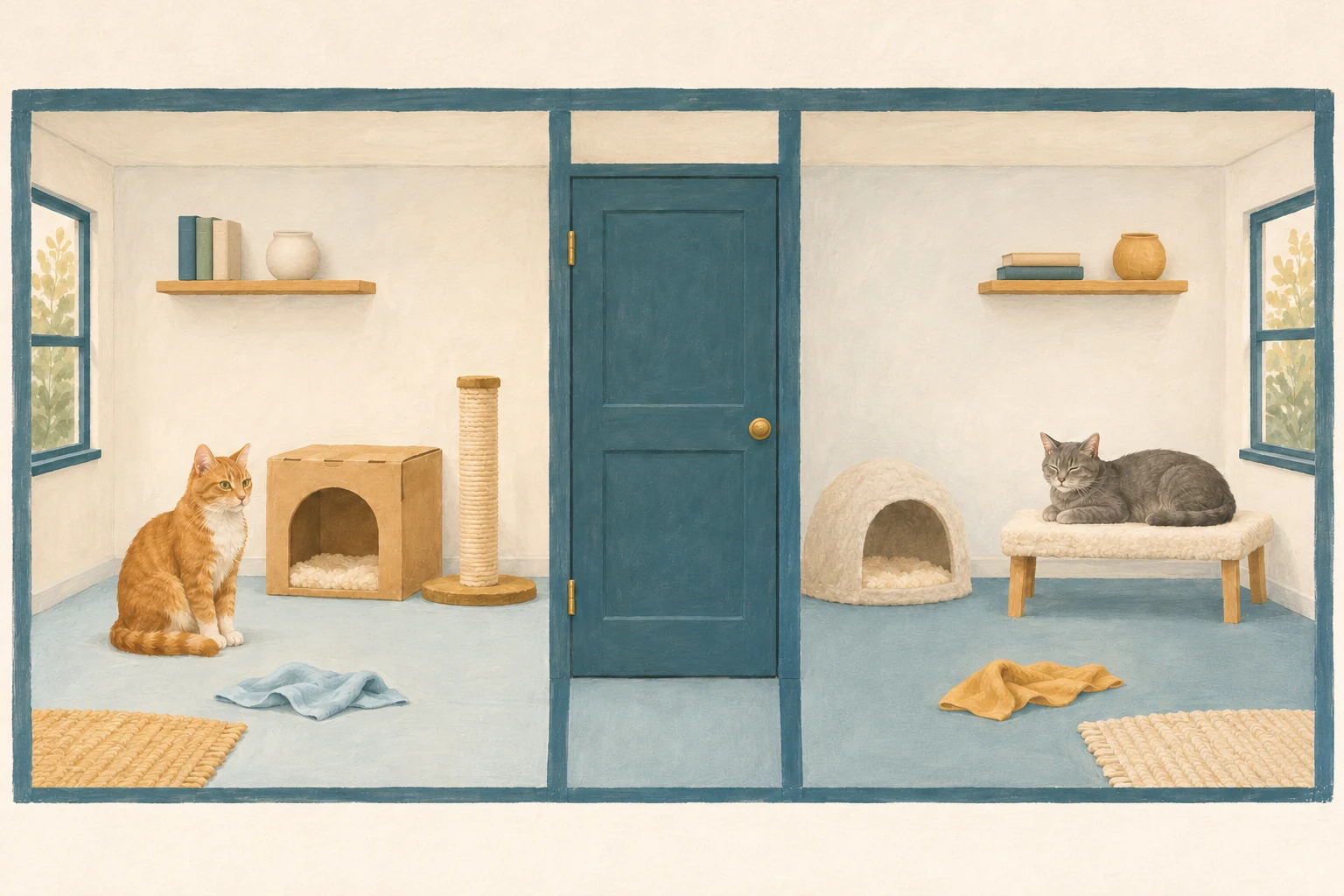
Separate spaces
Give each cat a usable retreat and its own resources.
Scent familiarity
Introduce scent gradually before direct contact.
A controlled view
Use a secure barrier that prevents jumping, climbing or contact.
Brief shared time
Supervise manageable meetings, with room to withdraw.
Basis: Feline veterinary guidance · UC Davis Veterinary Medicine
Begin with separate spaces
Prepare a quiet, secure room for the newcomer with their own essentials and places to hide or rest. Bring the cat there without arranging an encounter in the hallway. The resident cat should retain access to familiar areas and everyday care.
Allow the newcomer to become comfortable with the room and household routine before asking them to deal with another cat. Eating, resting and voluntarily exploring provide more useful information than simply counting days. Physical separation should prevent accidental meetings; everyone in the household needs to understand which doors must remain closed.
Ohio State University’s introduction guidance describes the purpose of this initial separation. Also discuss health records, examinations and any infection precautions with the veterinarian before contact. Behavioural readiness does not replace those precautions; the feline veterinary introduction handout includes health assessment as part of preparation.
Let scent come before contact
Once the cats are settled, offer bedding carrying the other cat’s scent. Let each cat investigate or ignore it. If either avoids it, hisses or changes their ordinary behaviour, remove the pressure and return to a comfortable stage.
The feline veterinary introduction guide uses gradual scent familiarisation before direct access.
Build pleasant experiences at a comfortable distance
Find out what each cat enjoys independently. A particular toy, a small food reward or calm attention may be useful, but the reward must be something that cat actually values. Two cats need not prefer the same thing.
Use these activities during manageable stages of the introduction, with separation or sufficient distance to prevent unwanted contact. The aim is for the other cat’s presence to accompany an experience that remains comfortable. Food should not be used to lure a hesitant cat into an encounter they are trying to avoid.
Keep the opportunities brief enough to finish while the cats remain engaged and relaxed. Increase exposure gradually across sessions. The Feline Veterinary Medical Association’s behaviour guidance also supports separate exploration of shared areas: one cat can investigate while the other is safely elsewhere with familiar comforts.
Add a view through a secure barrier
When scent and nearby activity no longer produce tension, a secure transparent or mesh barrier can allow visual contact without physical access. Check that neither cat can climb over, squeeze through or dislodge it. This is particularly important with small kittens.
Give both cats space to approach or move away. Keep early viewing sessions manageable, with places to retreat. A cat pressed into a corner has little control over the encounter, even if they remain silent.
End the view and increase distance if either cat becomes tense. Progress may involve returning to scent-only contact before trying again. Cats Protection’s introduction guidance describes this staged approach and stresses that meetings should remain voluntary. A barrier is a safety measure, not a reason to continue an encounter that is distressing either cat.
Keep the first shared visits manageable
Move to supervised physical access only after both cats are comfortable at the preceding stages. Choose a situation you can monitor closely and end safely. Start with a brief visit, keeping enjoyable activities available without requiring the cats to crowd together.
Quietly observe rather than repeatedly moving the cats towards one another. Gradually extend shared time when the encounters remain comfortable. Between sessions, return to the established separate arrangements while you are still assessing the relationship.
One uneventful meeting is useful progress, but it does not establish that the cats can be left together unsupervised. Look for a consistent pattern of comfort. If tension develops, reduce the challenge and repeat an earlier stage. UC Davis’s veterinary guidance emphasises that introductions vary between individuals and may require revisiting steps.
Watch both cats between meetings
Fighting is only one sign of difficulty. Prolonged staring, guarding a passage, hiding or refusing to enter a room can reveal that one cat is limiting the other’s choices. Notice which animal uses the bowls and trays, where each sleeps, and whether their usual interactions with people continue.
Friendly approaches, mutual grooming and resting in contact can indicate an affectionate relationship. Play should be reciprocal; repeated pursuit of a cat who is trying to escape needs intervention. An occasional brief disagreement needs context, including whether the cats remain comfortable with one another afterwards.
Record patterns rather than labelling one cat “the bully” and overlooking their circumstances. Changes in eating, grooming or toileting also need veterinary attention. The Feline Veterinary Medical Association’s guide to recognising tension explains both subtle and obvious signs.
Make the next encounter safer
Keep a solid barrier, such as a large piece of cardboard, ready to block the cats’ view and allow retreat. Do not reach between tense cats or pick them up; they may redirect distress towards you. Resume secure separation without punishing hissing. See the feline veterinary introduction handout.
Allow for later setbacks
Cats who previously got along may react differently after one returns from veterinary care. Unfamiliar smells or a medical collar can change the encounter. Prepare a quiet, secure indoor space where the returning cat can recover and follow the clinic’s instructions.
Observe the cats before allowing their usual access to one another. If either shows tension, return to separation and gradual familiarisation instead of expecting the old relationship to resume immediately. The returning cat may also have particular requirements for rest, medication or protection of a wound.
The Feline Veterinary Medical Association’s advice after veterinary visits explains why a familiar housemate can temporarily seem unfamiliar. Tell the clinic about the reaction so behavioural arrangements and recovery care can work together.
Get help when comfort is not improving
Seek veterinary advice promptly if tension persists, intensifies, affects normal activities or involves injury. Pain and illness can alter interactions. The veterinarian can examine the cats and arrange appropriate behaviour support rather than assuming the difficulty is purely social.
Avoid trying to establish a “dominant” cat or making the animals fight to settle the relationship. Feline relationships are more flexible than that explanation suggests. The Feline Veterinary Medical Association’s intercat tension guidance supports individual assessment and referral when needed.
Keep the rescue organisation involved if an adoption is not working comfortably. Discuss the cats’ welfare and the practical options without promising a deadline for friendship. Our rescue-cat arrival guide covers the newcomer’s wider settling-in needs.
Follow the evidence
Sources & further reading
Article sources checked 10 November 2026. Diagram sources checked 10 November 2026.
Follow a source for its full context, and check current government guidance for rules that may change.
- RSPCA Australia — What do I need to know about multi-cat households?kb.rspca.org.au
- Cats Protection — Getting another catcats.org.uk
- Ohio State University — New petsindoorpet.osu.edu
- Feline Veterinary Medical Association — Step-by-step guide: How to introduce a new cat to other cats in your homecatfriendly.com
- Feline Veterinary Medical Association — Behavior modification recommendations for multiple-cat householdscatvets.com
- Cats Protection — Introducing cats and kittenscats.org.uk
- UC Davis School of Veterinary Medicine — Introducing your new cat to your other household catshealthtopics.vetmed.ucdavis.edu
- Feline Veterinary Medical Association — How to recognize intercat tensioncatfriendly.com
- Feline Veterinary Medical Association — Decrease tension after a veterinary visitcatfriendly.com
- Feline Veterinary Medical Association — Intercat tensioncatfriendly.com