Published .
Suspected poisoning needs prompt advice, even when a pet still looks well. Call your veterinarian or an emergency veterinary hospital now if exposure may have occurred. In Australia, the Animal Poisons Helpline is 1300 869 738. If your animal is collapsing, struggling to breathe, having seizures or rapidly deteriorating, seek emergency veterinary care immediately; do not wait for an online reply.
These are signs of a veterinary emergency. This guide is for preventing accidents and preparing to explain an exposure. It cannot determine whether a particular amount is safe for your animal.
The starting point
At a glance
- Suspected poisoning needs prompt professional advice, even if the pet looks well.
- Keep the product label and details of the exposure ready for the call.
- Do not induce vomiting or give a home remedy unless a professional directs it.
When something has happened
Move other animals away from the material and prevent further access if you can do so safely. Keep the packaging or take a clear photograph of its label. Do not put yourself at risk handling a distressed animal or an unknown chemical.
Do not induce vomiting, give a home remedy, or give food or drink after a suspected ingestion until a veterinarian or the poisons service advises you. Treatment depends on the substance, route of exposure and animal's condition. Something appropriate in one case may cause harm in another. For contamination of eyes, skin or fur, ask for immediate instructions specific to that exposure. Animal Poisons Helpline emergency instructions.
Have the animal's species, weight, product name, approximate amount, time of exposure and current symptoms ready. Mention existing illness and anything already given. If the quantity is unknown, say so. Keep a note of who you spoke to and the next action; in a frightening moment, a written instruction is easier to follow than memory.
A safer home starts with access.
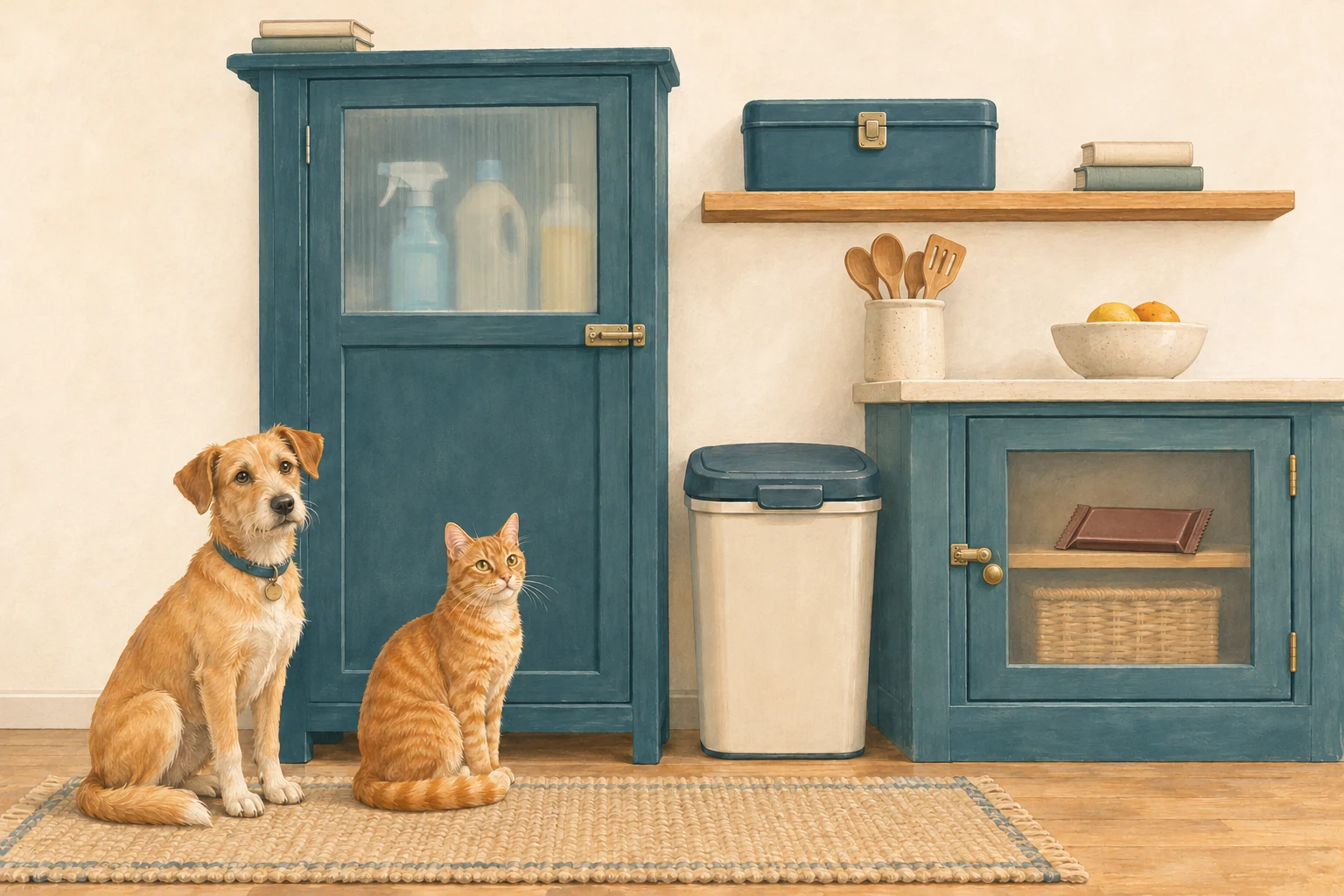
Secure storage
Keep medicines, chemicals and baits inaccessible.
Food and rubbish
Check bags, benches, cupboards and bin lids.
Plants and pet products
Identify plants and check species instructions on treatments.
Prepare for the call
Keep packaging and your veterinary contacts easy to find.
Basis: Animal Poisons Helpline · UC Davis Veterinary Medicine
Medicines need a storage plan
A bedside table, handbag or kitchen bench may be convenient for people and accessible to animals. Check where visitors put tablets, where a dropped capsule could roll, and how used packaging reaches the bin. A child-resistant lid is not a guarantee that a dog cannot chew the container.
Paracetamol is particularly dangerous to cats and can also poison dogs. Combination products may contain it without the word appearing prominently on the front of the packet. Never give a human medicine on the assumption that a smaller animal simply needs a smaller human dose. Veterinary use of any medicine requires the veterinarian's directions for that individual animal. Animal Poisons Helpline: paracetamol.
Keep animal medicines separately labelled too. A practical household rule is that one nominated person records each prescribed dose as it is given. This reduces confusion when several people are caring for the same pet. Store the original instructions with the medicine; a loose tablet in an unlabelled bag is difficult to identify during an emergency.
Food hazards hide inside ordinary products
Chocolate, grapes, raisins and sultanas deserve particular attention in kitchens and gift bags. Their presence in a cake, bun or mixed snack can be easy to overlook. Chocolate risk varies with the product and amount, while grape products can cause serious illness in dogs. Do not use a previous uneventful incident as evidence that another exposure is safe. Ask for advice using the actual ingredients and quantity available. Animal Poisons Helpline: food hazards.
Xylitol is a separate concern for dogs. This sweetener can cause dangerously low blood sugar and, with some exposures, liver injury. It appears in products such as sugar-free gum, sweets and oral-care preparations, and may be labelled birch sugar or E967. Symptoms can be delayed depending on the formulation. Keep the whole packet for identification and call promptly rather than waiting to see whether the dog becomes unwell. Animal Poisons Helpline: xylitol.
Onions and garlic are also hazardous to dogs and cats; cooking does not make onion safe, and onion powder can hide in seasonings and prepared meals. Serious effects on red blood cells can be delayed. Animal Poisons Helpline: onions and related plants.
Macadamias can poison dogs, including when baked into food. Alcoholic drinks can poison pets too, so clear unattended glasses and spills. Call for advice after suspected exposure and supply the full recipe or packaging; do not use a home “safe amount” calculation. Macadamia guidance and alcohol and entertaining hazards from the Animal Poisons Helpline.
Useful prevention questions are concrete: can the dog open the pantry, reach a school bag, or pull a shopping bag from a chair? Does the kitchen bin close securely? Who checks the floor after baking? Agree that visitors ask before feeding anything to the animals.
Flowers are not automatically safe indoors
True lilies and daylilies are a serious emergency risk for cats. Exposure can involve leaves or petals, pollen groomed from fur, or water from a vase. Kidney injury can be fatal. Keep these plants out of a cat's home and accessible garden, and seek veterinary care immediately after suspected exposure. Other plants with “lily” in their common name have different hazards; that does not make an unidentified bouquet safe. UC Davis veterinary guidance on lilies.
Before flowers arrive, tell family and regular visitors that the household has cats. Ask a florist to identify every component of a mixed arrangement. Keep a plant's botanical name or purchase label rather than relying on a photograph alone. If identification is uncertain during a possible poisoning, show the veterinary team the photograph and label; do not spend hours trying to settle the name yourself.
Check the species on flea and tick treatments
A product intended for a dog must not be assumed suitable for a cat. Australian labelling requirements for relevant permethrin dog products warn about severe toxicity to cats, including exposure through close contact with a recently treated dog. The correct product, dose range and separation instructions come from its label and your veterinarian. APVMA veterinary labelling requirements.
In a household with both species, read the packet before every application, even if the brand looks familiar. Keep each animal's treatment in its own labelled place. Plan where the animals will stay during any required separation before opening the product. If a wrong product has been applied, contact a veterinarian immediately and take the packaging; do not improvise a dilution or apply another chemical to counteract it.
Cleaning products, oils and fragrances
Cleaning safety depends on the product and its use. Concentrated products can be hazardous; instructions about dilution, ventilation and keeping animals away matter. A surface should not become accessible merely because a person has finished wiping it. Follow the label's directions for rinsing, drying and access, and ask the manufacturer or veterinarian when those directions do not address the animals in your home. ASPCA guidance on household products.
Essential oils also require care. Risk varies with the oil, concentration and route of exposure. Swallowing concentrated oil, contact with concentrated product on skin, and substantial exposure to vapour can cause problems. “Natural” is not a safety assessment for a particular pet. Do not apply oils to an animal or its bedding as an improvised flea treatment or calming remedy. Animal Poisons Helpline: essential oils.
Reed diffusers have an additional complication: the carrier liquid may contain alcohols or glycols as well as fragrance. A spill is therefore not assessed by the scent alone. Keep the bottle and ingredient information if exposure occurs. Animal Poisons Helpline: toxic alcohols.
Walk through cleaning day from the animal's perspective. Where will the pet wait? Can it enter a room through another door? Is a bucket left unattended? Can a cat reach the supposedly inaccessible shelf? Include cleaners, housemates and pet sitters in the same access plan.
Baits require more than hiding the packet
Rat and mouse baits can be attractive to dogs. With anticoagulant baits, serious bleeding may not become apparent for several days. A dog behaving normally just after eating bait still needs urgent professional assessment. Retain the product label because different rodenticides require different decisions; colour and shape alone are not adequate identification. Animal Poisons Helpline: rat baits.
Before any pest-control work, tell the contractor which animals live at or visit the property. Ask exactly what products will be used, where they will be placed, and what access restrictions apply. Keep that information available to every carer. The garden, garage and shared building areas belong in this conversation as well as the kitchen.
Make the emergency plan easy to use
Put your usual vet, an after-hours veterinary hospital and the animal poisons number in the household's shared contact list. Check how you would transport each animal and who could help if the usual driver were absent. A carrier buried behind storage boxes is not ready when time matters.
Repeat a short household check when something changes: a new pet, a visiting child, a medication change, a bouquet, a renovation or a pest treatment. Ask three questions: what new substance has arrived, how could this animal reach it, and who needs to know?
No list can cover every poisonous substance or every animal's circumstances. If an exposure is possible, professional advice about that event is more useful than a general “safe foods” list, a social-media anecdote or a promise on packaging. Call, explain what you know, and follow the plan made for your pet.
Follow the evidence
Sources & further reading
Article sources checked 10 November 2026. Diagram sources checked 10 November 2026.
Follow a source for its full context, and check current government guidance for rules that may change.
- University of Sydney — Signs of a veterinary emergencysydney.edu.au
- Animal Poisons Helpline — Emergency instructionsanimalpoisons.com.au
- Animal Poisons Helpline — Paracetamol and your petsanimalpoisons.com.au
- Animal Poisons Helpline — Food hazardsanimalpoisons.com.au
- Animal Poisons Helpline — Xylitol and dogsanimalpoisons.com.au
- UC Davis — Lily toxicity in catshealthtopics.vetmed.ucdavis.edu
- APVMA — Ectoparasiticides for dogs and catsapvma.gov.au
- ASPCA — Poisonous household productsaspca.org
- Animal Poisons Helpline — Essential oils and petsanimalpoisons.com.au
- Animal Poisons Helpline — Toxic alcoholsanimalpoisons.com.au
- Animal Poisons Helpline — Rat baits and your petsanimalpoisons.com.au
- Animal Poisons Helpline — Onions and related plantsanimalpoisons.com.au
- Animal Poisons Helpline — Macadamia nuts and dogsanimalpoisons.com.au
- Animal Poisons Helpline — Entertaining hazardsanimalpoisons.com.au